
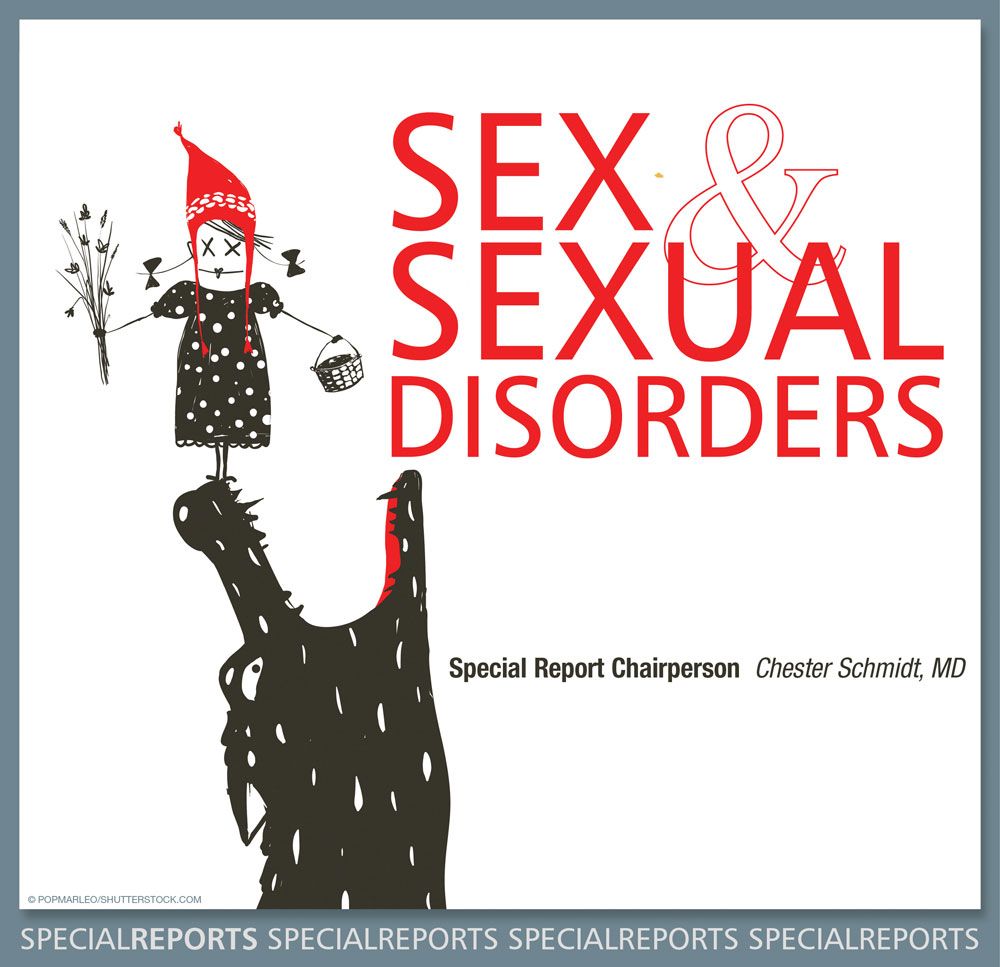








The changes in the newly approved DSM-5 loosen diagnosis and threaten to turn our current diagnostic inflation into diagnostic hyperinflation.
The changes in the newly approved DSM-5 loosen diagnosis and threaten to turn our current diagnostic inflation into diagnostic hyperinflation.

Historical records reveal Don Juan syndrome was a recognized diagnosis that referred to forms of hypersexuality and sex addiction.

Sexual identity development is a complex, multidimensional, and often fluid process. One must consider cognitive, social, emotional, cultural, and familial complexities among other aspects of the individual’s experience to contextualize a narrative concerning sexual identity development.

The DSM-5 Web site has recently been revised-the term “Pedohebephilia” disappears altogether, but the concept of “Hebephilia” lives on...

Diminishing libido is a symptom of depression, but antidepressants do not always restore sexual interest. Loss of desire may be the cause of depression, not its consequence. Dr Levine explains the nature of sexual desire and its relationship to arousal including the various biogenic, psychogenic, interpersonal, and cultural factors that contribute to problems associated with sexual desire.
Which tool is helpful in screening for sexual addiction? Is the symptom severity in women treated for substance abuse generally equivalent to that of males? Structural abnormalities in which brain areas have been associated with substance abuse? These questions and more in this quiz.

Ray Moynihan (who previously gave us the invaluable book "Selling Sickness: How Drug Companies are Turning us All Into Patients") has published a new expose titled "Sex, Lies, and Pharmaceuticals."

This 3-part manual on sexual disorders is edited by 2 psychiatrists who have been engaged for more than 20 years in clinical treatment of patients with sexual problems.
Consider the predicament of Mrs M, a 38-year-old premenopausal mother of two. Mrs M tells her primary care physician, “I just don’t have a strong desire for sex. It’s been about 10 years now, and I hardly ever have sexual thoughts or fantasies.

Fads in psychiatric diagnosis come and go and have been with us as long as there has been psychiatry. The fads meet a deeply felt need to explain, or at least to label, what would otherwise be unexplainable human suffering and deviance.
Consider the predicament of Mrs M-a 38-year old premenopausal mother of two. Mrs M tells her primary care physician, “I just don’t have a strong desire for sex."
A major general problem in the preparation of DSM5 is that the various Work Groups have been given far too little guidance and support. This explains why: 1)most of the criteria sets are written so obscurely and inconsistently; 2) the rationales for change vary so widely in depth and quality across Work Groups,and; 3) so many suggestions that should have no chance at all have made it this far without being tossed.
This 3-part manual on sexual disorders is edited by 2 psychiatrists who have been engaged for more than 20 years in the clinical treatment of patients with sexual problems. Drs Balon and Segraves bring their rich experience to this field. Patients who have sexual disorders need extra time to present their questions of doubt, confusion, misunderstanding, and perhaps guilt and shame. They also need clarification and understanding-and possible answers and reassurance.
From time to time, health conditions emerge that are relative “orphans” when it comes to having the resources of a health care discipline or subspecialty to take ownership or accept responsibility for developing the body of knowledge that underlies their systematic evaluation and treatment. Female sexual dysfunction (FSD) is such a class of conditions.
The study and treatment of human sexual problems should fall under the purview of clinical psychiatry. Sexual behavior is an important factor in most of our patients’ lives and may help define their sense of competence and serve as a force leading to interpersonal bonding
Because of recent scandals, pedophilia is one of the few psychiatric disorders widely known to the general public.
Paraphilias and paraphilia-related disorders (nonparaphilic sexual compulsivity or sexual addiction) are sexual disorders that predominantly afflict men.
Paraphilias as defined by DSM-IV, are sexual impulse disorders characterized by intensely arousing, recurrent sexual fantasies, urges and behaviors (of at least six months' duration) that are considered deviant with respect to cultural norms and that produce clinically significant distress or impairment in social, occupational or other important areas of psychosocial functioning. The common paraphilias described include exhibitionism (exposure of genitals to a stranger), pedophilia (sexual activity with a prepubescent child, generally 13 years of age or younger), voyeurism (observing others' sexual activities), fetishism (use of inert objects, such as female undergarments), transvestic fetishism (cross-dressing), sexual sadism (inflicting suffering or humiliation), sexual masochism (being humiliated, beaten, bound or made to suffer) and frotteurism (touching, rubbing against a nonconsenting person).
The diagnostic criteria for sexual addiction are derived from the behaviorally nonspecific criteria for addictive disorder that were presented in Part 1 (Goodman, 1998b), by replacing "behavior" with "sexual behavior".
Paraphilias as defined by DSM-IV, are sexual impulse disorders characterized by intensely arousing, recurrent sexual fantasies, urges and behaviors (of at least six months' duration) that are considered deviant with respect to cultural norms and that produce clinically significant distress or impairment in social, occupational or other important areas of psychosocial functioning.