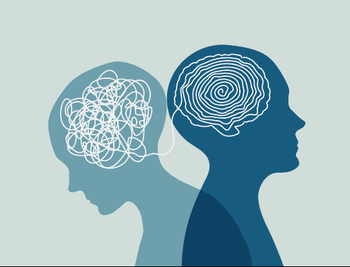
A remitted patient with ARFID faces panic after a crash, showing why recovery includes somatic fear, not just eating behavior.
Why artists feel like Sisyphus: therapy reveals family-driven rocks, reframes rejection, and helps creators embrace the grind with purpose.
CREATIVE MINDS: Psychotherapeutic Approaches and Insights
“Art is everywhere, except it has to pass through a creative mind.”
-Louise Nevelson
“One must imagine Sisyphus happy.”
So ends the famous essay, “The Myth of Sisyphus,” by Albert Camus. It is a last line that has puzzled—if not consternated—its many readers since the work’s first publication. Especially since Sisyphus was condemned by the gods to push a heavy rock to the top of a steep hill, only to have it come rolling down. At which point, his labors begin again. For all eternity.
I mention this particular myth because, in my 30-plus years treating creative patients of all stripes, it is the allegorical accompaniment to many of these patients’ most profound professional complaints. They refer to its powerful imagery of a person struggling to achieve a goal, overcoming physical and emotional exhaustion, until seemingly just about to attain that goal… only to have it aborted at the last minute, rejected for various reasons, compromised to a dispiriting degree, or otherwise ending in failure. Which means, if they want to continue pursuing their artistic goals, they have to start again. And again. And, more often than not, again...
Why is this connection to the myth of Sisyphus so regularly referenced by my patients? Why does this particular image resonate so strongly among the myriad artists, from the still-striving to the most successful, in my practice? It is because for the creative patient—whether writer, painter, composer, whatever—one of the most challenging aspects of the artistic life is the requirement merely to keep doing it. To continue writing, painting, or composing in the face of constant rejection from a fickle, sometimes brutal marketplace; or, even more acutely, in the face of the creative person’s self-recrimination, the shame at their perceived artistic failings. (I am thinking here of one patient’s ongoing attempts at writing a short story based on a traumatic event from her college days. She would regularly come to our session, take out the pages she had worked on that week, and, with tears in her eyes, rip them to shreds in front of me. She had wanted a witness to her shame and humiliation.) At such times, admittedly, Camus’ famous last line rings particularly false. I have often encountered creative patients whose frustration with the constant struggle of their professional lives seems in fact a direct refutation of the philosopher’s somewhat sunny notion. As a patient memorably said once when I’d mentioned the myth to him, “Fuck Sisyphus! No way that poor bastard’s happy. That’s just crazy.”
A would-be surrealist painter who’d battled unsuccessfully for years to find a gallery that would show him, he was tired of the unending cycle of intense work, broken promises and continual rejection he’d experienced, all supported by a series of menial jobs.
“Why should I keep going? Killing myself. Eating shit every day. What’s that famous saying? ‘Madness is doing the same thing over and over again, yet expecting a different result.’ Damned right.”
This brings us to the crux of the matter: is the requirement for consistent effort, the cycle of try-and-fail-and-try-again, a necessary and indeed (according to Camus) the only way to coexist with the basic absurdity of life? Or, instead, as the AA maxim quoted by my patient suggests, is such repetitive struggle—particularly in the arts—merely a recipe for failure or, at the very least, deep emotional distress?
In my view, and in terms of its therapeutic value, parsing out such a dichotomy is beside the point. For clinicians working with creative patients, I feel it is of greater importance to stay grounded in the person’s lived experience. Especially as it relates to core issues birthed in their family of origin. It is easy, for example, to tell a struggling artist—as friends and family often do—that they should do their art for the love of the thing, rather than for recognition or commercial success. (This apparently well-meaning support is usually accompanied by the suggestion that the artists should also consider getting a “real” job.)
But what if the ongoing struggle, the consistent effort to succeed in the face of quite formidable odds, is hampered or even negatively defined by old familial patterns? What if the creative patient is convinced that the seemingly endless struggle to succeed is not just “the cost of doing business” (as one patient put it) but the result of intrinsic defects in themselves?
I am thinking of one recent patient, a would-be novelist, who had compared himself with Sisyphus. (“Before he realized he was actually happy,” he added bitterly.) He was acute enough to understand that, after years of failing to acquire an agent to represent his work, his own self-defeating behaviors added to the usual difficulties of succeeding as a writer. And that these behaviors could be seen as a natural result of his belief in himself as basically defective.
With this in mind, we stayed with the image of the eternal efforts of Sisyphus as a framework to explore issues from within his family. As a child, he had endured the impossible expectations of his critical, demanding father, a man embittered by business failures. (An unhappy Sisyphus, I thought but did not say.) Seeing his own life as valueless, his father placed a great burden on my patient to be rich and successful. Then one day, during a session, my patient blurted out, “Dammit, it’s his rock I’m pushing up the hill! It’s not my rock at all.”
“Or maybe even your hill,” I offered.
Simple (and obvious) as it was, this awareness—concretized by the Sisyphian image—helped guide us in the direction of freeing him from the requirement to fulfill his father’s aspirations, and to begin delineating those goals that were genuinely his.
Moving from the specific to the general, especially in terms of a creative patient’s day-to-day experience, in his essay Camus posits that accepting the reality of what life actually is not merely offers the only way to make it bearable, but opens up the possibility of embracing it. “Leaning into it,” to use the current jargon.
Which reminds me of a veteran screenwriter patient, whose years toiling in Hollywood had resulted in his acceptance of the burdens of the artist’s life. “It’s a grind, baby!” he had announced with both well-earned pride and a broad, pained smile.
I smiled back, remembering suddenly an episode from the old Sopranos TV series in which Tony mentioned with similar resignation that his daily life as a mob boss was “a fucking grind.” So apparently no one is immune.
That includes clinicians, of course. We are no strangers to the “fucking grind” at times, to feeling like Sisyphus straining under the weight of that boulder. Those difficult moments when we are not sure how to proceed with a patient, when we struggle to understand the core issues underlying our patient’s distress, when the path through a patient’s trauma seems unclear or inadequate.
Frankly, if we are doing our job right, there is always the sense that the rock could start rolling back down the hill at any moment. What matters, though, is that—like Sisyphus—we just start rolling it back up there again.
The simple fact is that what is true for our creative patients is true for us clinicians. The work may be difficult, demanding, frustrating, and stubbornly unfulfilling at times—a grind. But it is our grind, and only the wholehearted embrace of its unalterable nature is the surest way to contentment.
As Robert Louis Stevenson said, “I have known happiness, for I have done good work.”
Maybe, on his best days, Sisyphus could say the same thing.
Mr Palumbo is a licensed psychotherapist and author in Los Angeles. His email address for correspondence is