AI might streamline psychiatric intake with avatar interviews and EHR-linked decision support, adding guardrails against hallucinations and enabling measurement-driven precision predictions.
Explore how AI transforms healthcare by enhancing diagnostics, personalizing treatments, and improving access while addressing significant risks and limitations.
It has been obvious for decades that US medical care is on an unsustainably wasteful course. We spend 18% of our GDP on healthcare ($5 trillion per year, $14,570 per person)—about twice as much per capita as most peer countries and over double the United Kingdom. The growth in US medical expenditure has been astounding—just 5% of GDP in 1960, 13% of GDP in 2000, 18% now, and is projected to be 20% within the next decade.1
The cruel paradox is that our extravagant health spending produces does not produce extravagant medical outcomes. In 1980, US life expectancy was equivalent to that of peer countries. It is now 4years below them—partly because we are the only developed country in the world that does not provide universal coverage, partly because we have unacceptably high rates of drug overdoses, gun deaths, obesity, poverty, smoking, accidents, infant/maternal mortality, and chronic disease.
The US consistently ranks last among countries in ratings of overall health system performance. We suffer from a massive misallocation of resources—providing excessive, unnecessary, and often harmful care to people with good paying insurance, along with woefully inadequate or no care to people who have poor or no coverage at all. Our healthcare systems are monopolies that dominate local markets and extort exorbitant rates—every medical procedure is priced much higher in the US than in peer countries. We will discuss here the ways artificial intelligence may come to the rescue, then its risks and limitations.
Improving diagnosis:
Diagnostic errors occur in about 10 percent of patients, causing iatrogenic harms, unnecessary worry, and suffering. Mistakes are inevitable in any complex task, but are more likely when patients are seen by overstretched doctors working in a fragmented system of care. Chatbots are more systematic than humans, know everything in the medical literature, see patterns we cannot see, work faster, and never tire. Still, we cannot trust them to make autonomous clinical decisions because chatbots make mistakes—sometimes egregious ones. So, the wave of the future will be clinician and chatbot teams— more accurate than either humans alone or chatbots alone. Hybrid care will produce better outcomes, less harmful overtreatment, and reduced cost.
AI will have its first and greatest impact on imaging. It can detect patterns in the data at much higher resolution than even the best human eyes, has access to millions of scans (far beyond the experience of any individual clinician), and is less subject to the bias of recent clinical experience. Studies reveal that AI can exceed the performance of doctors, but best success occurs when AI and clinicians work together. And there will be even greater accuracy when all 3 billion imaging procedures conducted every year become part of the AI database (more than 95 percent of the data from these scans is now unused).2
Improving treatment planning:
Chatbots are extremely valuable in treatment planning. Knowing everything in the scientific literature, they can instantaneously summarize the benefits and harms of every treatment option. AI integrates patient care by reducing drug-drug interactions and the risk that multiple specialists caring for each patient may work at cross purposes. Chatbots improve patient compliance with medication and visit reminders and 24/7 support to answer questions. Chatbots are also more consistent and systematic in collecting data for initial evaluations and follow-ups.
Speeding up drug development:
AI can predict specific molecular targets that are most likely to produce effective vaccines or medications much faster and more cheaply than the traditional trial and error process of drug discovery. It can analyze and see patterns in vast genetic and proteomic data sets far better than humans can. AI can also predict what are a candidate compound's likely indications, efficacy, side effects, interactions, and manufacturing specs. It can find new uses for old drugs and old uses for new drugs. Robot labs run cheaply and 24/7. Its ability to predict physicochemical properties, bioactivity, and toxicity allows AI to outperform all previous drug discovery methods in creating drugs that optimize therapeutic effect while limiting risk. Current drug trials are extremely costly, take many years to complete, and rarely result in approval. Patient specific genome analysis reduces clinical trial time by almost a third.3
Personalizing genetics:
Artificial intelligence is crucial in analyzing the enormous data sets generated in genetic studies—seeing genetic patterns we cannot see, and personalizing findings that likely would be lost in the huge pile of data. AI is also integral in finding targets for gene editing.4
Improving access to care:
AI goes a long way toward solving our shortage of physicians, their geographic maldistribution, and the insufficient time allotted to each patient. On average, physicians spend less than 30% of their workday with patients—the rest is taken up with administrative work and record keeping. Artificial intelligence creates efficiencies that allow doctors to spend more time with each patient and to see more patients. It can process, record, and transfer data far faster than humans and can translate opaque medical terminology in a way that is readily understood by patients.5
Integrating care:
AI can reduce clinical costs by reducing the excessive and overlapping testing and treatment that results from patients having multiple doctors who do not coordinate well with one another. This results in greater specificity of care, fewer medical mistakes, better allocation of scarce medical resources, and greater medical equity. For example, the integration of AI in atrial fibrillation screenings resulted in a decrease in cost of almost 75% per quality-adjusted life year. Large cost reductions have also been achieved in diabetic retinopathy, dental, and breast cancer screenings. Reducing unneeded testing and treatment reduces costs, improves outcomes, reduces medical harms, and avoids patient discomfort.6 AI has reduced costs by 13% in the testing of individuals with metastatic colorectal carcinoma. The integration of AI into predictive areas can reduce hospital stays by 25%, saving money while also increasing the patient's quality of life.7
AI privacy:
This may be an oxymoron. The massive data storage of sensitive information invites breaches capable of penetrating even the most sophisticated encryption. There is also no absolute guarantee that data collected for one purpose will not be sold, shared, or misused for another. Informed consent is not informed when it is buried in the fine print. We must find ways to ensure that patients' health information stays where it belongs within the healthcare team.
Physician acceptance:
Physicians like AI when it reduces their administrative work, record keeping, and increases time with patients. They may not like AI when it is an added burden (because new apps are often poorly integrated with existing systems), increases malpractice liability (does responsibility for AI mistakes fall on them rather than the hospital or the AI supplier?), or threatens to replace their role. Doctors also worry about deskilling as they become more dependent on AI for information and assistance in decision making. Regardless of concerns, usage is expanding rapidly, nearly doubling between 2023 and 2025.8
Patient acceptance:
About half of patients are currently mistrustful about the inclusion of AI into their care.9 It is important that they understand that AI is just a tool supervised by their physicians, not an independent decision maker.
Transitional problems:
New AI apps often do not integrate well with old hospital systems. The costs of licensing, initial integration, and continued operations can be high. New technology will rapidly make obsolete tomorrow what is cutting edge today. Staff will require constant retraining on the newest app. Every step of the way is likely to be pricey.
Legal liability:
Patients who suffer from poor outcomes related to AI mistakes or misinterpretation may sue the doctor, the hospital, and the AI company. It is not clear who should be held responsible for how much, and not clear how the question should be settled in each case and system-wide.10
Big AI takes over healthcare:
Healthcare is the biggest industry in the US. Big AI has access to more money than it knows how to spend and will be providing the healthcare industry with its basic infrastructure. It is no great leap to imagine Big AI taking increasing control of healthcare via joint ventures, outright purchase, or licensing agreements. In a previous piece, we decried the fact that AI morality that puts profits first is a very far cry from Hippocratic morality which puts patients first.11
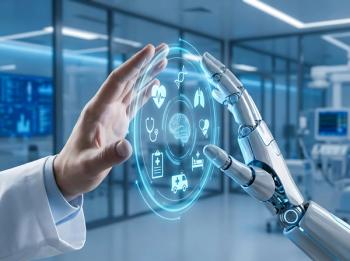
Artificial Intelligence will inevitably be an increasingly integral part in healthcare—not as a replacement for human physicians, but rather as a tool and partner. AI will improve diagnoses and treatments; personalize medical decision making; increase access to care; speed up drug development; reduce healthcare costs; and help solve our physician shortage. But the risks and limitations are also appreciable, and we must strike a balance between the opposites of blind optimism and reflex rejection. AI must be a tool that supports clinicians, but does not replace them.
References
1. Current health expenditure (% of GDP). World Bank Group. December 12, 2025. Accessed January 30, 2026.
2. How AI is improving diagnostics, decision-making and care. American Hospital Association. Accessed January 30, 2026.
3. Paul D, Sanap G, Shenoy S, et al.
4. Dara M, Dianatpour M, Azarpira N, et al. The transformative role of artificial intelligence in genomics: opportunities and challenges. 2025. Accessed January 30, 2026.
5. Sinsky C, Colligan L, Li L, et al.
6. El Arab RA, Al Moosa OA.
7. Al Meslamani AZ.
8. Heinrichs H, Kies A, Nagel S, et al.
9. Fritsch SJ, Bickenbach J, Marx G, et al.
10. Pham T.
11. Frances A, Reynolds CF, Alexopoulos G. Medical morality vs chatbot morality. Psychiatric Times. October 14, 2025.