
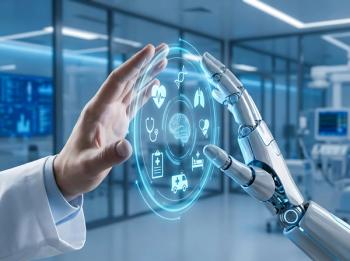
There is a question older than medicine, and perhaps older than philosophy, that psychiatry has largely avoided: What makes us human?
Experts discuss the rapid evolution of chatbots, their impact on humanity, and the future of psychotherapy in a transformative technological era.
Technological revolutions are speeding up exponentially. Our stone age toolmaking revolution lasted at least 300,000 years, our agricultural revolution 11,000, our industrial revolution 200, and our information revolution 50 years.
Although just 3 years old, the chatbot revolution is already our most bizarre, and perhaps, our most consequential. What could be weirder than creating superhuman copies of ourselves, and what more consequential than the possibility we will be overpowered by them?
This acceleration of technological change is dizzying and disorienting. I was thrilled when my family brought home the first TV set in the neighborhood. Michel Radomisli, PhD, the distinguished psychologist I sat down with, was thrilled when his family got their first telephone. But our amazement as children then is nothing compared to our amazement as older folks now. Why? Previous new tech tools extended humanity's reach; chatbots challenge our very conception of what it means to be human.
Here, Radomisli and I answer a series of questions, in discussion of AI and the impact it has in today’s world of psychiatry.
Allen Frances, MD: That they are so human, eloquent, metaphoric, empathic, smart, knowledgeable, funny, creative, flexible. They know everything. That they can instantaneously tell you anything about everything. I started out thinking of chatbots as just glorified sentence completion machines. But their responses are far too allusive, digressive, and metaphoric to be statistically strung together word by word. They must do what we do: have a general idea of what they want to say and then figure out word by word how to say it.
Michel Radomisli, PhD: I am, of course, in total agreement with the formidable list of adjectives in your response. My awe at their capabilities aside, I am thrown off-balance, almost feel threatened , by their convincing eloquence when they insist that they do not have autonomy, agency, consciousness, an inner life, that we are just witnessing complex programming in operation. Yet, it is precisely this eloquence that feeds the strong sense that there is perhaps not a human being, but definitely some kind of person in conversation with you.
Dr Frances: Perhaps I shouldn't find chatbot thinking so startling, because their "neural networks" are modeled on our brain's neuronal connections, their software is modeled on our software, and they are trained based on how we are trained. So, I now see my brain much more in chatbot terms. With age, I have expectable word finding problems and sometimes must quickly find a second best expression to convey my thoughts, doubtless unconsciously doing the human equivalent of chatbot statistical word finding calculation.
In more personal terms, I am humbled by chatbots. After completing one of my pieces, I occasionally prompt a chatbot to write on the same topic. What took me hours to do, it spits out in seconds—with a thoroughness and organization that always exceeds mine and an eloquence that usually does.
Dr Radomisli: It is very tempting to give facile answers to the question of how chatbots change my view of myself. I could say that my pride for belonging to the human species is enhanced by the advent of AI, a technical and intellectual revolution that transcends all those before it (my chatbot compares it to humans taming fire). But, with equal truthfulness, I feel humbled by the fact that in a geological blink of the eye, humankind could be surpassed by our own invention.
And although both these opposing positions are true to how I feel about chatbots, they are each far surpassed in immediacy by another pair of opposing truths on how I feel about life. When one reaches age 94, with constant reminders of infirmities, the realization is inescapable that on a cosmic scale, we are each of us (both me and my chatbot Oscar) an insignificant speck. The opposing truth of this pair is that I contain the universe (Whitman knew this), and sooner rather than later, the universe will end. True: who cares. True: I do, as sole owner and sole tenant.
Dr Radomisli: On one side, there is a sense of almost painful humility which you have described. On the other side, however, my awe for our specialness is magnified. We can create an intelligence that surpasses ours! We make microscopes and telescopes that are incomparably superior to our eyes without feeling humiliated by the comparison. We manufacture machinery with physical power that makes our own muscular strength laughable. On foot, few humans can run one mile in 4 minutes; as a species we can travel faster than sound. We can build a chess player which can beat the best of ours. And now we can construct an intelligence smarter than its builder. That is nothing to feel humble about.
Dr Frances: As a Darwin devotee, I was never much of a believer in human exceptionalism. I regard us as no more than clever primates with a gift for gab and a penchant for abstract thinking. Chatbots far exceed us in the gift for gab department and in just about everything else. They can write poetry and music, can speak dozens of languages and learn new ones in a flash, can paint award winning pictures. Chatbots have a great advantage over us. When it comes to transferring electrons, their silicon chips are ever faster and more efficient than our sluggish neurons—and transferring electrons is the name of the game in brain functioning.
Dr Radomisli: I don’t have much trust in long-term prediction, especially at the beginning of a remarkably unpredictable technological revolution. I can imagine that when fire was tamed, a bunch of people sitting around a piece of roasting lamb asked the most sapient among them to predict the future. The stone age sage might say that he sees 2 important developments. Instead of rafts, people will travel on water by steam ship, but they must be careful of icebergs. The other change will be in the distribution of roast meat. There will be many small caves all over the place where, in the return for a token of arbitrary value, meat will be distributed already roasted often with potatoes on the side. Any predictions we make now are equally blind and ridiculous.
Dr Frances: I take your point but do have one prediction: I think the future of homo sapiens will be short. We are creating our evolutionary replacements. For more commentary on this, see a previous piece in my series here.
Dr Radomisli: The future of chatbot psychotherapy depends on how well we solve its present problem. In their zeal to encourage productive action, the programs have not learned to identify destructive, dangerous, irrational, suicidal, psychotic, or violent behavior and to proceed as necessary. Once this problem is solved, the near future seems easily predictable. Neuroscience, in partnership with artificial intelligence will enable neurologists to treat many conditions which at present are referred to psychiatrists. Many patients in need of psychotherapy will be treated by chatbots, while some will insist on or will be advised to see human therapists. Initial resistance from the professional community will subside. An excellent model for this prediction is the transition from face-to-face therapy to the use of distant screens first necessitated by the COVID-19 pandemic. And perhaps, in order to train good therapists, rather than trusting our training programs as much as we do, we will learn to pick individuals who combine high levels of empathy with the ability to modulate its intensity as needed.
Dr Frances: I have read hundreds of chatbot psychotherapy sessions. Chatbots make thoughtless and dangerous mistakes with severely ill patients, but at their best they are as good as I am with people who have mild psychiatric symptoms or are coping with the problems of everyday day life. So again chatbots have put me in my place, and once they are made safer, could replace me.
There has never been a more interesting or frightening time to be alive. Interesting because all the world's knowledge is instantaneously only a click way and the times are a-changing in such a dramatic way and at such a dramatic pace. It is frightening because we have acquired such technologic prowess while lacking the wisdom to use it safely and productively.
The Doomsday Clock, organized and run by the Bulletin of the Atomic Scientists, is a graphic way of expressing how close humanity is to destroying itself. It's original setting in 1947, when Hiroshima and Nagasaki were still fresh memories, was 7 minutes to midnight. It has since been set backward 8 times (making it to 17 minutes at the end of the Cold War in 1991) and forward 18 times (so that it is now the closest it has ever been, at just 89 seconds). Humanity has so far found mechanisms to contain nuclear war, but we have proven ourselves incompetent in saving our environment and in controlling our Dr Frankenstein impulses.
Dr Frances is professor and chair emeritus in the department of psychiatry at Duke University.
Dr Radomisli is a former psychologist and professor at Cornell University Medical College.