
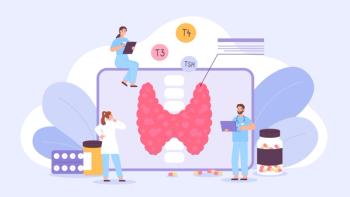
An endocrinologist warns psychiatrists against overreading peripheral thyroid hormones and flags kelp and T3 microdosing as underrecognized risks.
A TSH alone usually suffices, serial testing can feed anxiety, and age-specific ranges matter, an endocrinologist tells psychiatrists.
THE PSYCH CONSULT: SECOND OPINION
In this episode of “
The discussion centered on a composite case of a 34-year-old woman with 3 months of low mood, anhedonia, fatigue, poor concentration, and an 8-pound weight gain, with a Patient Health Questionnaire-9 (PHQ-9) score of 14. She also reported cold intolerance, dry skin, and constipation, and had a family history of hypothyroidism in her mother and sister. Without a clear stressor, Brandon noted, the presentation could easily be labeled first-episode major depressive disorder if the somatic features were overlooked.
Unless a central process such as pituitary apoplexy is suspected, Messer said a thyroid-stimulating hormone (TSH) level alone is generally sufficient. Peripheral hormones carry many confounders: heparin can raise T4, physical or psychological stress can lower T3, and abnormalities in thyroid-binding globulin distort total levels. SSRIs often lower free T4, which Messer described as a mild central hypothyroidism rather than a spurious result.
Because hypothyroid symptoms are nonspecific and common, Messer cited the Colorado Thyroid Disease Prevalence Study, which screened more than 25,000 health fair attendees, to illustrate that many people without thyroid disease report such symptoms.1 She added that in blinded studies, patients rarely become symptomatic until TSH exceeds 10.
Age also shifts the reference range. In a National Health and Nutrition Examination Survey analysis, the 97.5th TSH centile was 3.56 mIU/L for adults aged 20 to 29 years and 7.49 mIU/L for those 80 years and older, and 70% of older adults with TSH above 4.5 mIU/L fell within their age-specific range.2 Messer cautioned against diagnosing hypothyroidism in a depressed older adult with a TSH near 7.
Repeated, patient-initiated TSH testing offers only transient reassurance, the speakers agreed, and diurnal variation can produce changes that heighten health anxiety. Brandon suggested pairing any testing with cognitive behavioral strategies aimed at accepting a stable baseline.
For levothyroxine, Messer said taking it 20 to 30 minutes before food is practical, missed doses can be doubled the next day, and iron, calcium, proton pump inhibitors, and phosphates should be separated by 4 hours. A patient with a consistently normal TSH does not need a change in routine. Symptom improvement can lag TSH normalization by months.
High-iodine supplements such as kelp can trigger permanent hypothyroidism in patients with Hashimoto thyroiditis or hyperthyroidism in those with TSH receptor antibodies. Microdosed T3 at 5 mcg is unlikely to cause harm if TSH is not suppressed, she said, but meta-analyses have not supported T3 augmentation for refractory depression. For patients on lithium, she recommended a baseline TSH, a repeat at 1 month, then every 6 months.
“Be very careful looking at the peripheral hormones; they can really confuse you,” said Messer.
Brandon closed by noting that thyroid peroxidase antibody positivity raises the risk of progression to overt hypothyroidism, that evidence does not support treating subclinical hypothyroidism to augment antidepressants, and that curbside consultation with endocrinology remains a valuable step.
Dr Brandon is the founder and medical director of Whole Body Psychiatry. She is dual board-certified in adult psychiatry and consultation-liaison psychiatry, and specializes in gut-brain health.
Dr Messer is a double-board certified endocrinologist and the founder of both
References
1. Canaris GJ, Manowitz NR, Mayor G, Ridgway EC.
2. Surks MI, Hollowell JG.