
Let's take a look at the next generation of pharmacotherapies for mood and anxiety disorders.
Let's take a look at the next generation of pharmacotherapies for mood and anxiety disorders.

In this inaugural episode, experts discuss the limitations of current diagnosis-based frameworks in suicide research, emphasizing the need for more targeted interventions.
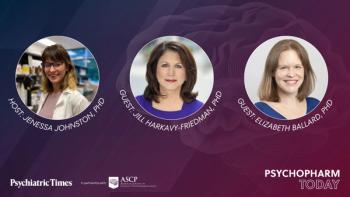
In the first ever episode of "Psychopharm Today," experts unpack why suicide needs its own research, how to design targeted studies, and what clinicians can do beyond diagnosis to reduce risk.

Discover an objective suicide risk assessment for patients denying ideation, using Suicide Crisis Syndrome and staged warning signs to guide earlier intervention.

Blood exosomal microRNA markers reveal oxidative-stress subtypes, predict psychosis conversion, and guide early, targeted treatments like MitoQ.
Yale psychiatrists test esketamine vs IV ketamine for resistant depression, probing long-term safety, side effects, and misuse in real-world care.
APA’s upcoming DSM shifts from “statistical” to “scientific,” adding dimensional, contextual, and biological factors to modernize diagnosis and address past critiques.
After FDA’s new warning, experts stress controlled data show acetaminophen in pregnancy isn’t tied to autism or ADHD; confounding fuels scares.
New evidence shows CBT timed after ketamine boosts lasting depression relief; Yale tests digital therapy Rejoyn to scale the neuroplasticity window.
APA’s next DSM rebrands and adds context, cross-cutting symptoms, and biomarker-ready science to sharpen diagnoses and personalize psychiatric care.
New analysis finds postpartum depression and postpartum psychosis have distinct underlying biological mechanisms.
Weighing the risks and benefits of stimulants to treat ADHD.

Review the highlights from last week's meeting of the American Society for Clinical Psychopharmacology.
Review the origins and advancements of ECT.

Luvesilocin enters phase 2, hinting at lasting relief after 1–2 doses and a new 5-HT2A model.
Phase 2 data suggest luvesilocin quickly eases postpartum depression with durable remission and minimal breast‑milk transfer, supporting larger trials.

S. Nassir Ghaemi, MD, shares highlights from the ASCP task force consensus on psychiatric polypharmacy, emphasizing monotherapy and diagnostic reassessment.
ASPIRE survey reveals fatigue and cognitive impairment reduce work abilities and quality of life in narcolepsy and idiopathic hypersomnia, exposing unmet needs.

Phase 3 at-home data show sublingual dexmedetomidine cuts severe agitation in bipolar disorder and schizophrenia, supporting FDA label expansion.

Patient selection, monitoring, and counseling on dissociation are critical to safe ketamine treatment.
DT-120, an optimized LSD formulation, shows lasting anxiety relief and high remission at 12 weeks, as researchers share detailed phase 2b safety insights.

Real-world claims show opioids remain common in fibromyalgia despite guidance, highlighting safety concerns and interest in FDA-approved non-opioid option Tonmya.
Phase 2b data show DT‑120, optimized oral LSD, delivers durable GAD remission with mostly same‑day side effects; phase 3 trials advance.
ASCP awardee Leslie Citrome explains why effect size, NNT, and NNH beat P-values, helping clinicians choose treatments tailored to each patient.

At the 2026 ASCP Annual Meeting, Eric Konofal, MD, PhD, argued that sleep assessment should become a routine part of ADHD evaluation and treatment.

Phase 3 data show COMP360 psilocybin rapidly lifts treatment-resistant depression, with durable MADRS gains and stronger effects from 2 sessions.

A phase 2b/3 trial of Forvisirvat in major depressive disorder is investigating potential sex-specific antidepressant effects in women.
Expert psychiatrists share new ASCP deprescribing guidance, tackling overprescribing, primary-care challenges, and practical tapering strategies to improve safer, patient-centered mental health care.
Award-winning psychiatrist Steven Moffic, MD, urges psychiatry to elevate social, spiritual, and moral care, tackling burnout, tech, and ecological ethics.
Clinicians explore transdiagnostic anhedonia—reward learning, loneliness, and digital rewards—offering practical ideas to personalize treatment.